 |
 |
 |
 |
 |
 |
 |

 |
|
 |
 |
|
 |
 |
 |
 |
 |
|
 |
 |
 |
 |
 |
|
 |
 |
|
| |
 |
|
 |
| |

|
This page was updated on:
March 13, 2011
|
| |
| |
|
|
|
|
| |
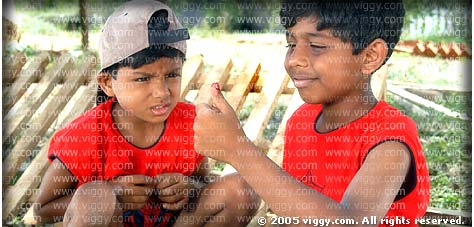
Thutturi - film review
P. Sheshadri is back with a bang again after three consecutive
National Awards and his genuine efforts to address serious
social concerns continue with Thutturi! And this time, he
uses children as the medium to showcase these serious issues.
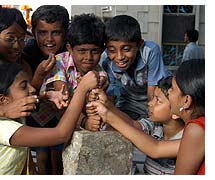 Put
a few children together to be themselves. Lo! They create
a wonderful world of their own deriving immense pleasure in
playing - and `learning' through it sub-consciously. It is
the natural way of `growing'. Playing in open space is quite
different from playing within the four walls like in modern
families. Open space provides greater scope for interaction,
experimentation and learning besides multiplying the thrill
of playing. There lies the imperative need for playgrounds.
But thanks to the indiscriminate growth of concrete jungles
of ever-growing cities, where there is hardly any open space,
let alone proper playgrounds - particularly in the localities
where poor and middle class children reside. Put
a few children together to be themselves. Lo! They create
a wonderful world of their own deriving immense pleasure in
playing - and `learning' through it sub-consciously. It is
the natural way of `growing'. Playing in open space is quite
different from playing within the four walls like in modern
families. Open space provides greater scope for interaction,
experimentation and learning besides multiplying the thrill
of playing. There lies the imperative need for playgrounds.
But thanks to the indiscriminate growth of concrete jungles
of ever-growing cities, where there is hardly any open space,
let alone proper playgrounds - particularly in the localities
where poor and middle class children reside.
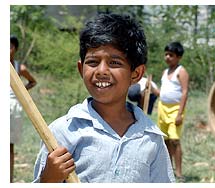
Thanks to blazing publicity, cricket and computer games seem
to be the only games most city children are exposed to. Arrival
of a village boy Shivalingu (Kartik) opens them up to the
joys of rustic village games. Broken glasses, obstruction
to traffic etc leads parents to `advise' children not to play
in the streets. They go out in search of a place to play and
find a vacant land full of stones & thorns. They plead with
the owner of that land - a well-meaning lonely old man (Dattanna)
left to himself with a lot of riches and also a lot of health
complaints. With his permission, children cleanup the whole
place and 'Tata' helps them creating a beautiful playground
with novel ideas drawn from David Werner's famous book on
creative use of readily available things around. Mingling
closely with children helps him regain his zest for life.
His health starts improving.
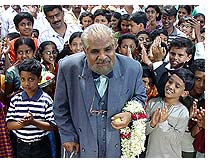
 Old
man's only son Hari (Dharma), settled in America, is not happy
with his father's association with `street children' as he
calls them. He arrives on the scene with his little son Abhi
(Kishan). Abhi derives great joy playing with other kids,
despite of Hari's objections. Businessman Hari decides to
demolish the playground to build a commercial complex despite
of children's pleadings & parents request. Unable to see their
fruits of labor (playground) going out of their hands, children
outburst and results in interesting climax! Old
man's only son Hari (Dharma), settled in America, is not happy
with his father's association with `street children' as he
calls them. He arrives on the scene with his little son Abhi
(Kishan). Abhi derives great joy playing with other kids,
despite of Hari's objections. Businessman Hari decides to
demolish the playground to build a commercial complex despite
of children's pleadings & parents request. Unable to see their
fruits of labor (playground) going out of their hands, children
outburst and results in interesting climax!
Director Sheshadri unfolds many concerns and issues pertaining
to today's children - from play grounds to stress of today's
children to extinguished village games to parent's prestige
hampering kids' childhood... He raises a problem through children
and gives a solution through them! Though it carries very
serious message, he balances it so beautifully, every kid
will enjoy it for sure! And hence, he made Thutturi a film
for everyone - from eight to eighty! Of course there are some
shortcomings. Glaring one is the length. The movie also caries
some sort of noise at times. Children screaming in chorus
looks quite odd as well!
 Karthik
Sharma is superb as Shivalinga. Aniruddh, Kishan have also
done a great job. Veteran actor Dattatreya (Dattanna) could
have underplayed that character a bit. He looked over acting
at times. Dharma has a good role in the film and he did his
bit well. Karthik
Sharma is superb as Shivalinga. Aniruddh, Kishan have also
done a great job. Veteran actor Dattatreya (Dattanna) could
have underplayed that character a bit. He looked over acting
at times. Dharma has a good role in the film and he did his
bit well.
Apart from children, it is cameraman H.M. Ramachandra and
music director Hamsalekha who makes the film worth watching.
One can see the pain of shooting on the busy and tiny streets
of Bangalore Ramachandra's camera. Hamsalekha has given some
hummable songs like 'cricket, cricket'. Totally the film is
worth watching. Don't miss it.
Direction: P. Sheshadri
Producer: Jaimala
Music: Hamsalekha
Cinematography: H.M. Ramachandra
Cast: H.G. Dattatreya, Dharmendra,
Suchendraprasad, Master Karthik Sharma, Master Anirudh, Master
Puneet, Master Pratham, Baby Namratha etc
|
|
| |
|
|
|
| |
|
|
| |
|
|
|
| |
This news in Kannada |
|
|
| |
|
|
|
Quick
Links
|








 Wow! This site is very good. We are proud to have such a site. Most updated information about the kannada films and many more stuffs. Keep it great going…